
Why a Twin Screen Cabinet Earns Its Floor Space
Floor space is the most expensive asset in any arcade. Furthermore, every cabinet you install has to justify its footprint every single day. A twin screen shooting arcade machine answers that question in three ways.
First, it doubles the player count per machine. One cabinet, two guests, one round. As a result, the queue clears twice as fast during peak hours.
Second, it turns a solo activity into a contest. Because both players see their own live score on their own screen, the round becomes a head-to-head match. In addition, the final tally invites an immediate rematch, which lifts repeat play on the spot.
Third, it holds attention. The lit marquee and twin displays create a bright, moving focal point. Meanwhile, the attract mode keeps the cabinet presenting itself to passers-by between rounds. Therefore, the machine continues to pull in new players even during quiet periods.
What to Look For in a Two Player Shooting Arcade Machine
Before you compare models, check the details that decide whether a cabinet performs well or frustrates guests.
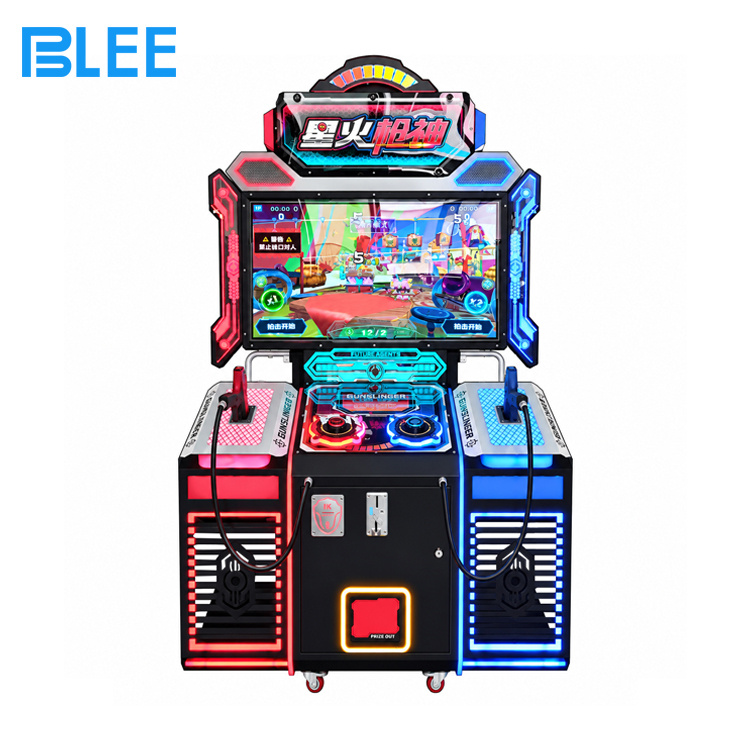
A dedicated screen for each player. Each station should carry its own screen mounted under a shared marquee. As a result, both guests follow their own view of the action, and neither has to lean across the other. Meanwhile, the two screens can present the same scene, which keeps the contest fair.
Colour-coded player stations. A clear split between the two sides saves time and confusion. On the BLEE cabinet, the left station is red, the right station is blue, and the on-screen player marker matches the station. Consequently, guests recognize their own station within seconds, and staff can direct a queue without a lengthy explanation.
Mounted gun controllers. Look for gun controllers fixed to the deck rather than loose on the floor. Because the controllers stay mounted, they cannot be carried away or dropped. In addition, an ergonomic grip matters, since a shooting cabinet takes heavy daily handling.
Individual control panels. Each player needs their own way to start a round, pick a stage, and confirm a choice. On this model, one station carries a row of round buttons, while the other carries a joystick with buttons. Therefore, both guests act from their own side instead of leaning over a shared panel.
A central payment console. The payment area should sit within easy reach of one attendant. A centre console with payment slots and a lit start button does exactly that. Furthermore, the illuminated button also signals to new guests where a round begins.
Audio, footrests, and casters. Speaker panels on both sides carry the game audio, and a footrest platform below each station keeps players comfortable through longer sessions. In addition, caster wheels under the base let staff reposition the cabinet during floor layout changes or cleaning.
How a Round Runs
A short, repeatable sequence keeps the queue moving.
1. Both players take their positions at the red and the blue station.
2. Each player starts a round from the centre console or from their own panel.
3. Both players aim the mounted gun controller at their own screen.
4. Each player hits the targets that appear in the game world.
5. The screens show the live score, the timer, and the multiplier while the round runs.
6. The round ends, the results appear, and the next pair steps up.
For background on target-based attractions, you can explore this reference on the shooting gallery format: https://en.wikipedia.org/wiki/Shooting_gallery_(carnival_game)
Estimating the Return on a Two Player Cabinet
Operators usually judge a shooting cabinet on throughput and replay rather than on a single round.
Throughput is simple to estimate. First, note the average round length. Next, multiply the number of playable rounds per hour by the price per play. Finally, compare that figure with a single-player cabinet, which serves one guest at a time. Because a twin screen unit serves two players per round, the hourly capacity is roughly double on the same footprint.
Replay is harder to predict, but visible scores help. When both players see the live tally, the losing side usually asks for one more round. Furthermore, the attract mode and the lit marquee keep the machine visible between sessions, which brings in new players without staff involvement.
Frequently Asked Questions
How many players can play at the same time?
Two. Each station has its own screen, its own gun controller, and its own control panel, so both players are active from the first second of the round.
Who is this machine built for?
The cabinet targets competitive arcade audiences. The two player format and the live score suit teenagers, adults, and head-to-head player groups, while the short round length keeps casual players moving through.
What kind of shooting does the machine use?
The cabinet uses two mounted gun controllers aimed at the player screens. Please contact our team to confirm the current controller type and the game list for your order.
What are the dimensions and the power supply?
Our team will confirm the size, the weight, and the power supply for your configuration. Please ask for the current figures before you finalize a floor plan and an electrical point.
Can the game content and the cabinet design be customized?
Yes. OEM and ODM customization is available for colours, themes, and branding. You can read more about our service here: https://www.bleearcade.com/oemodm-service/
What is the minimum order quantity and the lead time?
The MOQ is 1 PCS. In addition, stock units ship in 4-7 working days, and production orders take 12-30 working days. Shipping is available by sea, by air, or by express.