
Why a Physical Control Still Wins Attention
Every entertainment floor eventually reaches the point where one more screen based cabinet adds very little. That is usually the moment an interactive ball rolling arcade machine earns its place, because it asks guests to move something physical instead of tapping glass.
Touchscreens are familiar, and familiarity is also their weakness. Visitors who do not think of themselves as gamers tend to walk past a cabinet that looks complicated. A large ball does the opposite, because it reads as approachable before anyone plays it. That matters when a venue serves families, mall traffic or mixed age groups.
There is a social effect as well. Two guests standing at one cabinet talk to each other while they play, and that conversation is a stronger invitation than any sign. Passers by hear the reaction, stop, and look for a free side.
The nature of the skill matters too. The ball responds to a smooth release rather than rapid inputs, so a child’s timing can beat an adult’s strength. When a game is fair in that way, the losing guest usually asks for another round instead of leaving. For background on how amusement machines are classified in the trade, see the reference link near the end of this article.
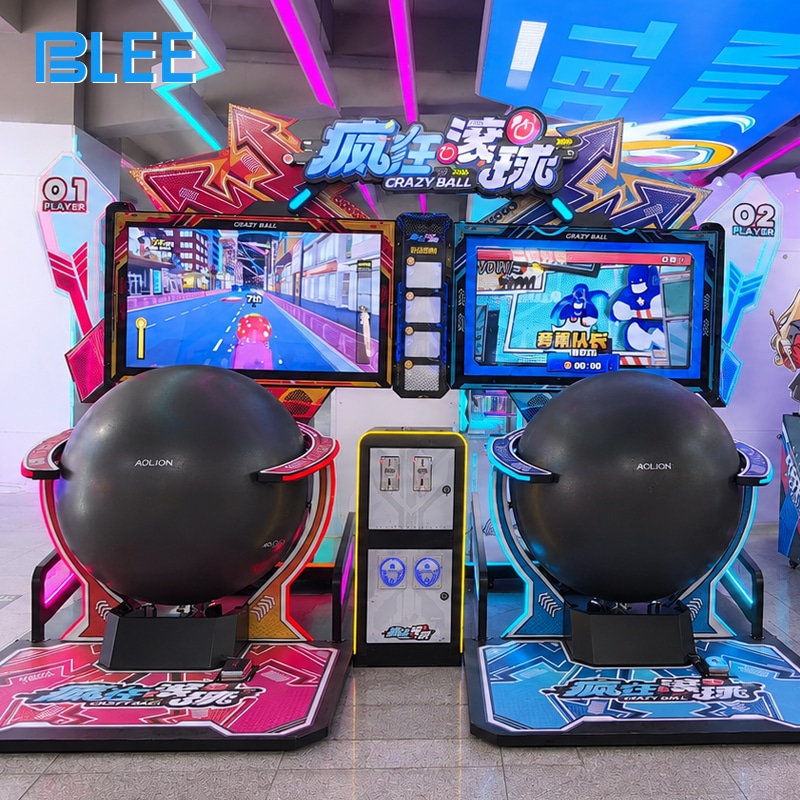
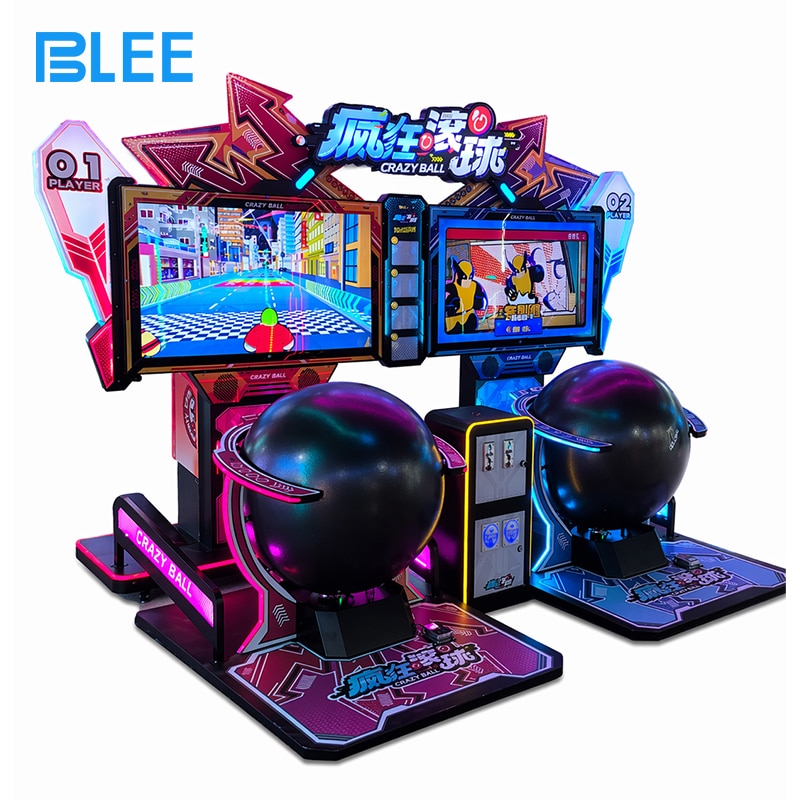
Panel by Panel: What the Cabinet Offers an Operator
Where guests look first. An illuminated marquee carries the game name and a set of angled graphic panels, so the cabinet identifies itself as Crazy Ball from across a mall corridor.
How guests pick a side. Star shaped plates sit on the left and right wings, marked 01 PLAYER and 02 PLAYER. Nobody has to guess where to stand.
How staff manage a queue. One station is finished in pink, the other in blue. During a busy hour, a staff member can point at a colour instead of explaining a position.
Where money changes hands. A single tower between the two screens holds the coin or token entry, a card reader position and a lit row of buttons. Payments and small faults are handled in one spot rather than two.
What hands actually touch. Each open platform carries one large ball resting in a curved cradle, with the game branding repeated in the floor graphics.
Why the lighting is not decoration. Edge lighting runs along the cabinet body and both platforms, so the machine stays visible when the room is dimmed for evening trade.
Two Stations, and What That Changes for You
The number that matters for a floor plan is not how many cabinets you own. It is how many guests a single bay can serve.
Companions stop waiting. A pair, a pair of siblings or a parent and child can both play during the same round. On a single station machine, one of them stands idle, and idle companions are the main reason a group leaves early.
Proximity produces rematches. Head to head play creates an immediate result to argue about, and the rematch follows naturally while both guests are still standing there.
Audiences form quickly. A cabinet showing two results at once gathers a small crowd, and a crowd draws further players without any extra promotion.
A worked example you can redo with your own numbers. Capacity follows the length of a round. Divide 3,600 by your typical round length in seconds to get the rounds one station can host in an hour, then double it for the cabinet. A 60 second round therefore works out at roughly 120 plays per hour across both stations, before queue limits and before any replay behaviour is applied. Substitute your own round length and your own venue averages rather than relying on this illustration.
Placing the Cabinet on Your Floor
Because the cabinet is freestanding, it can sit against a wall or stand in the open. Four practical points are worth checking before you commit a bay.
Sightline. The cabinet earns money by being seen. A position that catches the main walkway usually outperforms a quiet corner, even if the corner is tidier.
Player clearance. Two guests stand side by side, so both platforms need room for a person to step up, and the ball needs space to move on the platform.
Staff access. Keep the centre tower reachable without leaning over a player, because that is where the payment hardware sits.
Audience space. Onlookers are part of the attraction. Leave enough room beside the cabinet that a watching group does not block an aisle.
Confirm the actual footprint with the factory before you finalise the plan.
The Figures to Confirm Before You Commit
Published facts
- Product type: interactive ball rolling arcade machine (Crazy Ball series)
- Stations: two, marked 01 PLAYER and 02 PLAYER
- Ball: one large rolling ball per station, held in a cradle
- Displays: two screens, one per station
- Controls: centre tower with coin or token entry and a row of push buttons
- Cabinet artwork: neon pink and blue colour zones with branded floor platforms
Quoted per order
- Cabinet dimensions: To Be Confirmed
- Net and gross weight, crate size: To Be Confirmed
- Voltage and power draw: To Be Confirmed
Those three lines are open because each cabinet is built to the configuration on the order, and the listing does not publish fixed numbers. Ask the team for the current figures before you reserve a bay or arrange an electrical supply.
Trade Terms, Lead Time and Delivery
- Brand: BLEE
- MOQ: 1 PCS
- Place of origin: Guangzhou, China
- Packing: 4-7 working days for stock orders, 12-30 working days for production orders
- Shipping: by sea, by air or by express delivery (DHL, FEDEX, UPS)
- Payment terms: D/A, T/T, Western Union, Paypal, Others
Two decisions sit behind those lines. If your opening date is fixed, a stock order is the safer route. A production order gives more room for configuration, but it needs a longer runway. Freight mode then changes the landed cost more than any other item, so compare sea, air and express quotes before you approve a budget. Ask the team to convert their quote into a landed figure for your city, including your local charges.
If you want your own venue identity on the cabinet, artwork and branding can be discussed as part of the OEM and ODM service: https://www.bleearcade.com/oemodm-service/
Keeping Both Sides Running
Most of the hardware sits behind panels, so daily care is short and mostly about the parts guests touch.
- Wipe the balls and the platform surfaces between sessions, because hands are on the ball all day.
- Check each cradle so every ball settles back into a stable rest position.
- Keep food and drink away from the play platforms.
- Keep the payment mechanism in the centre tower clean so it stays responsive.
- Follow the manual for routine checks.
Two independent stations also make fault finding simpler. Each side has its own ball and its own screen, so a problem can be narrowed to one station. Ask the team which spare parts they recommend you hold for your region.
Buyer Questions
We have never operated an arcade machine. Is that a problem? No. Guests need no instructions because the ball is the control, and staff only need the payment settings plus a cleaning routine. Ask the team to walk you through the setup for your market.
Can it run on the power we already have? Voltage and power draw are quoted per order, so send your venue’s supply details to the team and they will confirm the match before dispatch.
Do the two stations interfere with each other? Each station has its own ball, platform and screen, so the two sides run independently. Ask the team how single player use is handled during quiet hours.
Can the cabinet carry our own branding? Artwork and branding are part of the OEM and ODM service, and the details are on the service page linked above.
What should we inspect when it arrives? Check the packaging, both screens, both balls, the cradles and the centre tower. Photograph any transit damage and contact the team before you sign off.
How many units should we start with? Start from your peak footfall and the number of bays you can give up, then ask the team for layout advice before ordering more than one cabinet.
Related Ball Attractions
- BLEE Rainbow Ball Arena Interactive Ball Skill Game Ticket Redemption System Precision Rolling Challenge https://www.bleearcade.com/product/blee-rainbow-ball-arena-interactive-ball-skill-game-ticket-redemption-system-precision-rolling-challenge/
- Lucky Ball Shaker Arcade BLEE Interactive Prize Mixer Chance & Skill Redemption Game https://www.bleearcade.com/product/lucky-ball-shaker-arcade-blee-interactive-prize-mixer-chance-skill-redemption-game/
Further Reading
For background on how coin operated entertainment developed as a public pastime, see this industry reference: https://en.wikipedia.org/wiki/Arcade_game
Next Step
The Crazy Ball cabinet solves a specific problem on a busy floor: it keeps two guests occupied in one bay, using a control that nobody has to be taught. Guests walk up, take a ball, and play. Send your venue type, available space and target opening date to the BLEE team, and they will come back with the current figures, the game list and a shipping plan for your market.